
A History of the Brazilian Military Dictatorship
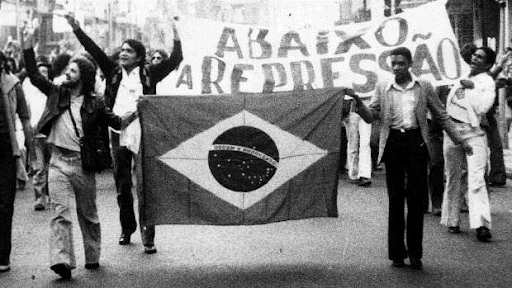
In 1964, a group of generals with civilian support and tacit approval from the United States overthrew Brazil’s democratically-elected government and initiated twenty-one years of authoritarian rule. Against the backdrop of the Cold War, officials in the American government and the Brazilian military feared the reformist appeals and purported Communist ties of President João Goulart. The Lyndon B. Johnson administration backed the coup d’état, offering diplomatic and financial support to the new regime.
Opening the Archives contains hundreds of documents from the John F. Kennedy and Johnson presidential libraries with a wealth of information regarding U.S. assessments of Goulart, the situation in Brazil beginning in the early 1960s, and deliberations regarding Goulart’s potential ouster as well as his ultimate removal from office. Taken together, these primary sources illustrate fading U.S. confidence in Goulart as a reliable partner over time. The president was variably seen as feckless, conniving, conspiratorial, and incompetent by American observers in Washington and Brazil. With the success of the Cuban Revolution on January 1, 1959, the United States fretted over the fate of Brazil, the largest and most influential country in Latin America. Goulart’s reformist agenda cost him the support of the military and alarmed conservatives who already distrusted him. American support for the coup was important but not decisive. Goulart’s fall was engineered in Brazil by Brazilian actors.
Opening the Archives holds thousands of documents that shed light on the early years of military rule, including analyses of the new regime’s character, its potential as a U.S. ally in the Cold War, and its ability to foster political stability and economic development. The regime was authoritarian from the start, but it maintained a veneer of democratic legitimacy in order to avoid the pejorative connotations of a military dictatorship. By late 1968, the emergence of legal and radical opposition forces led to a government clampdown and the use of censorship, repression, and torture to silence regime critics. In the early 1970s, Brazil became known internationally for the government’s gross violation of human rights. Opening the Archives is a rich resource for those seeking to understand how the U.S. government dealt with shifting public perceptions of the Brazilian military regime. Indeed, the collection contains thousands of documents pertaining to human rights abuses, economic development, armed resistance, political repression, U.S. aid, and myriad other topics.
As documents contained in this collection reveal, some U.S. government officials expressed reservations about the authoritarian nature of the Brazilian military regime. Nevertheless, Washington generally supported the dictatorship throughout the 1960s and the early 1970s.
Opening the Archives is especially valuable in understanding the political and diplomatic calculations that went into determining the American position vis-à-vis the situation in Brazil. The collection also allows researchers to note the shift in U.S. policy toward Brazil in the late 1970s when American officials began using human rights as a yardstick for evaluating whether or not to support military regimes around the world. This new standard fostered tensions between the Jimmy Carter administration (1977-1981) and that of General Ernesto Geisel (1974-1979).
As part of a slow-motion return to democracy in the late 1970s, the Brazilian regime passed an Amnesty Law that freed most political prisoners and allowed exiles to return from abroad, but it also shielded all state actors involved in torture from prosecution. Opening the Archives presents thousands of documents containing U.S. assessments of Brazil’s dictatorship political system, economic struggles, and social movements. During the presidency of Fernando Henrique Cardoso (1995-2003), the Brazilian state began offering monetary compensation to individuals who could prove the military regime’s responsibility for their arrest and torture or their loss of employment during the dictatorship. Yet, no one involved in the death of 400 individuals by agents of the state or in the arrest and torture of an estimated 30,000 dissidents has been held criminally responsible for their actions.
